

Standing desk use is at an all-time high, reshaping office wellness. But picking the best electric standing desk for 2026 isn’t just about hype: it’s about buying smarter and safeguarding your health—while dodging durability headaches and common user regrets. Here’s a realistic, evidence-backed guide to navigate market trends, health data, complaints, and features so you can confidently invest in a standing desk that actually delivers.
Key Takeaways
- Electric standing desks now dominate the market—over 9.5 million already in U.S. homes and offices, fueled by hybrid work and wellness priorities (source).
- Alternating sitting and standing reduces neck, shoulder, and lower back discomfort by up to 54% according to RCTs, but excessive standing brings its own risks (source).
- Buyer frustrations center on noise, wobble, complex assembly, and short or unhelpful warranties—so inspect product specs, repairability, and service terms before you buy in 2026.
- Market Snapshot — adoption, size and segment trends
- What the Evidence Says — proven health benefits
- Documented Risks & Long‑term Concerns — what to watch for
- User Complaints — electric vs manual desks
- Cost, Warranties & Service Expectations in 2026
- Leading 2026 Features & Specs that Matter
- Quick Buying Checklist
- Shortlist & Selection Rationale
- Sustainability & Materials
- Three Crucial User Questions Top Articles Miss
- Practical Usage Tips & Setup
- Wrap‑up: Recommendation Matrix & Next Steps
- FAQ
Market Snapshot — adoption, size and segment trends
Standing desks have gone from a niche wellness trend to mainstream, essential office furniture. The standing desk market reached a value of around $8.1 billion in 2024 and is forecast to hit $12.3 billion by 2032, growing at a robust 5.3% CAGR (Market Reports World). In the United States, over 9.5 million standing desks are now found in homes and offices. North America commands about 35% to 39% of global revenue, driven by workplace modernization and corporate wellness spending (Strategic Market Research).
Importantly, electric height-adjustable models now own the largest market segment. By 2024, more than two-thirds of Fortune 500 companies had implemented sit-stand workstations as part of their wellness initiatives. This is less a passing phase than a durable trend. Learn more about current market growth for standing desks here.

What the Evidence Says — proven health benefits (short & medium term)
The appeal of standing desks is grounded in legitimate health data. Peer-reviewed randomized controlled trials (RCTs) and systematic reviews show that alternating between sitting and standing reduces neck and shoulder discomfort by up to 54%, and lower back pain by about 32%. Using a standing desk can decrease your daily sedentary time by 68–78 minutes. There’s also evidence of improved blood pressure, glucose regulation, and vascular function (source, Healthline).
For mid-career office workers, this means measurable pain relief and less “slump fatigue,” especially when workdays are structured to cycle standing with sitting. Here’s the formula most studies recommend:
- Alternate sitting and standing every 30–60 minutes, not standing for prolonged periods (see evidence-based sitting/standing schedules).
- Use standing intervals for focused tasks; sit for intensive computer work.
- Total daily standing time should add up to 1–2 hours, spread over the day for best effect.
For a more detailed review of the benefits, see peer-reviewed health findings for standing desks.
Documented Risks & Long‑term Concerns — what to watch for
But there’s a catch: standing too long comes with its own problems. Recent large-scale observational studies (including a 2024 Australian study of 83,000+ participants) found that prolonged standing did not reduce the risk of cardiovascular disease—and may increase the risk of varicose veins, leg swelling, dizziness, and joint strain (CNN).
Here’s how to avoid these pitfalls in your standing desk routine:
- Set timers to cue you to switch between sitting and standing modes.
- Use an anti-fatigue mat and supportive shoes, especially on hard floors.
- Start with short standing intervals (20–30 minutes) and work upward, paying attention to symptoms such as leg fatigue or swelling.
- If you have a history of vascular or musculoskeletal issues, consult an ergonomics or occupational medicine specialist before heavy use.
Learn more about the health risks and best practices for safe standing desk use.
User Complaints — electric vs manual desks (what buyers complain about most)
User reviews reveal the real-world frustrations of standing desk ownership, and these differ notably between electric and manual models. Electric height-adjustable desks routinely receive complaints for:
- Noisy or jittery motors, especially at heavier loads
- Wobble or excessive sway when typing, especially at higher heights
- High initial price and (sometimes) complex assembly
- Lift mechanism failures—blocked motors, dead control panels, power/software glitches
- Permanent reliance on wall power
By contrast, manual crank or gas-lift desks are:
- Praised for quiet operation, fewer mechanical failures, and lower price
- Cited for complaints of physical effort and slow, sometimes uneven, adjustments
- Limited in height range and sometimes wobble more with cheaper frames
Recent design upgrades—like dual motors, anti-collision sensors, and steel crossbeam frames—help address many electric desk complaints but can push prices higher. For a comprehensive look at real user ratings and troubleshooting, check out consumer standing desk ratings and reviews.
Cost, Warranties & Service Expectations in 2026 — what to budget for
Expect to pay anywhere from $300 for entry-level models to $1,500 (or more) for premium features, larger sizes, and smart integrations. Electric desks, thanks to their motors and control systems, always command the higher price bracket, but buyers report that “high purchase price” and post-sale service failures are among their top frustrations (source).
Warranty and service are big differentiators:
- Premium electric desks should come with warranties of 5–10 years (motor, electronics, and frame).
- Scrutinize which parts are covered—some only protect the frame, not the motor.
- Look for brands with proven repair and parts replacement reputation (many fail here).
Manual desks are usually cheaper and simpler to fix, but always check for frame flex and wobble, especially at higher weights. Explore price comparisons and warranty tiers in our Electric Standing Desk Cost Guide 2026.
Leading 2026 Features & Specs that Matter (noise, load, speed, anti-collision, controls)
What sets the best electric standing desk 2026 apart? Innovation in electric standing desks is accelerating. Here are the make-or-break specs:
- Noise Level: Quiet operation below 40 decibels is now standard for premium models. Noise is a leading user complaint.
- Dual- or Belt-drive Motors: Offer smoother, faster, quieter, and more stable lifts even under heavy loads.
- Weight Capacity: 275–330 lbs is typical; avoid anything below 200 lbs if you have a heavy workstation.
- Anti-Collision Sensors: Essential for safety—prevents pinched fingers, gear jams, and motor failures.
- Wobble Ratings: Seek desks with robust steel frames, cross-beams, and positive “wobble test” reviews at max height.
- Smart Controls: Bluetooth/wifi, programmable memory, phone integrations, and desk usage analytics are becoming common in mid-to-premium desks.
- cable management: Built-in trays and grommets keep home office spaces tidy.
Upgrade prioritization: If noise and stability matter most (shared spaces or video calls), prioritize dual-motor, robust frame models with documented sound tests. Heavy desktop setups (multiple monitors, equipment) require higher weight ratings and steel frames.
Quick Buying Checklist — how to pick the right electric standing desk in 2026
- Height Range: Confirm minimum and maximum—should fit your entire team or household.
- Weight Capacity: At least 220 lbs for average users; 300+ lbs for multi-monitor or equipment-heavy setups.
- Motor Type: Dual-motor (or higher) for smoothness and long-term reliability—avoids the “single-motor wobble” problem.
- Noise Level: Prefer models independently tested below 45 decibels.
- Wobble: Always perform the “wobble test” (desk at full height, tap corners and check for excessive sway).
- Warranty Length: 5+ years for motor/frame; avoid “lifetime” with fine print exclusions.
- Assembly Complexity: Can two people reasonably assemble it in under 90 minutes?
- Cable Management: Integrated tray, grommets, and no sharp edges.
- Sustainability: Look for FSC/PEFC-certified wood, recycled steel, low-VOC, and published take-back or repair programs.
- Red flags: Short motor warranty (<3 years), zero mention of anti-collision, poor user reviews on frame durability or service.
For top picks in each category, review our up-to-date Best Electric Standing Desk 2026 guide.
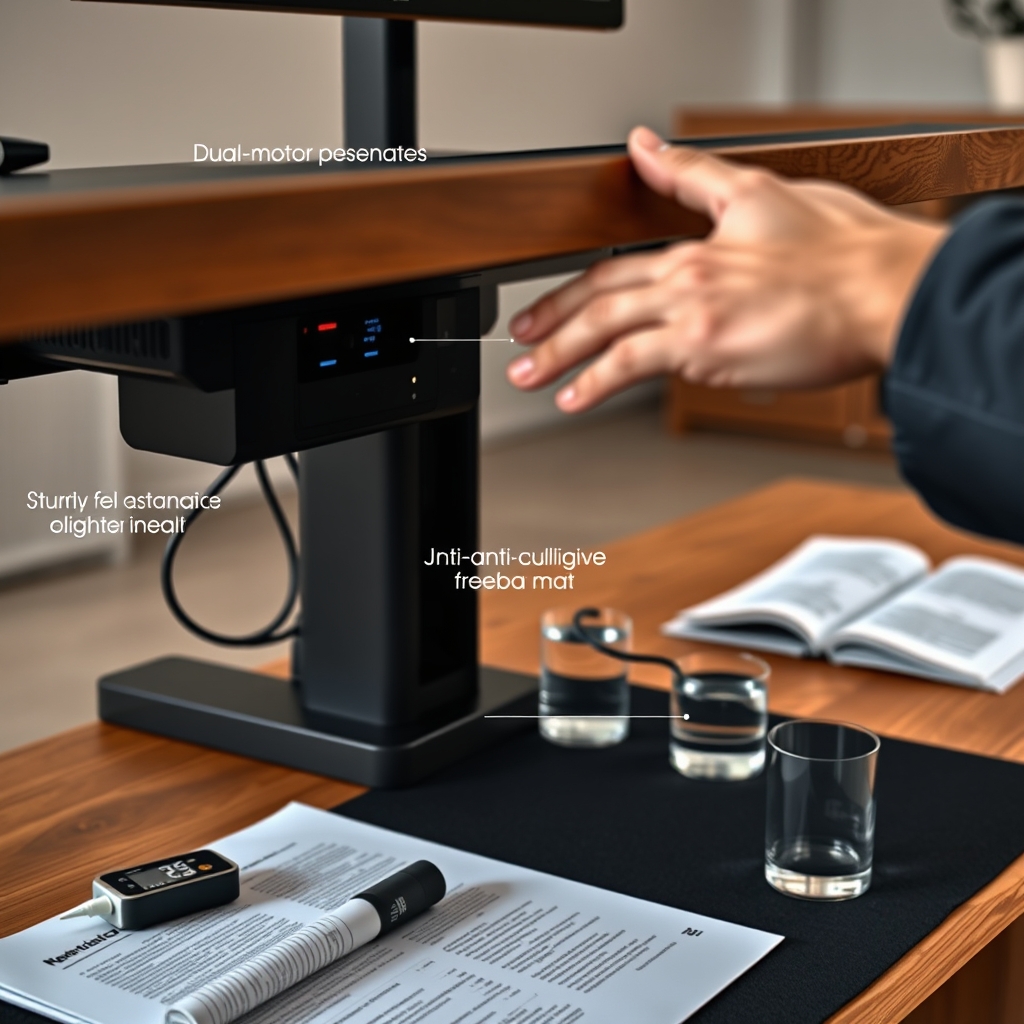
Shortlist & Selection Rationale (how we’d pick the top models)
To select the best electric standing desk 2026 candidates, we combine:
- Peer-reviewed durability tests (motor cycle life, frame flex tests)
- Noiseless <40 dB operation at all heights
- Minimum five-year comprehensive warranty (not just frame)
- Transparent service and parts policies, with proven “mean time to failure” data >35,000 up-down cycles
- High average user reviews for stability, electronics, and customer support
- Documented sustainability practices and certificates
- Value score: balancing total cost, warranty, assembly, and reliability
Sample shortlist categories for 2026:
- Best Value: Solid dual-motor, 5-year warranty, sub-$700
- Best for Heavy Users: Superior steel frame, 350+ lb capacity, wobble resistant, 7–10 year warranty
- Best for Quiet/Home Office: Noise <38 dB, ultra-smooth lifting, easy cable management
Explore our methodology and see model-by-model picks in our standing desk shortlist guide.
Sustainability & Materials — what to ask manufacturers
Sustainability is now a defining factor for premium desk buyers. In 2024–2026, top brands are differentiating with:
- FSC or PEFC certified wood sources
- Recycled steel and aluminum content in legs/frames
- Low-VOC finishes and adhesives
- Full material disclosures (wood, metal, plastics, electronics)
- Take-back and recycling programs—plus published repair manuals or upgradable parts
Vital questions to send to manufacturers before ordering:
- “Can you provide chain-of-custody certificates for wood and steel used in this desk?”
- “Does your warranty cover repair and replacement parts beyond the frame?”
- “Is there a published take-back or recycling program for end-of-life desks?”
For more on this, read our guides to Sustainable Standing Desk Materials and Repair/Upgrade Paths for Standing Desks.
Three Crucial User Questions Top Articles Miss (and how we address them)
- Q1: What is the optimal standing/sitting interval for long-term health?
RCTs show alternating every 30–60 minutes is best. Long-term observational data suggest standing beyond 2 continuous hours increases vascular and joint risks. Use sit-stand timers and anti-fatigue mats for safe use (source). - Q2: How durable are electric desks, and how do I verify warranty and repair coverage?
Look for published “mean time between failure” stats (min 25,000 cycles), warranty covering motors/electronics for 5+ years, and available spare parts. Contact vendors for official repair/part policies (Wirecutter). - Q3: How do I check if sustainability claims are real?
Request documentation: FSC/PEFC certificates, recycled content audits, and explicit material disclosures. Avoid vague “eco-friendly” claims with zero third-party proof.
For more details, see our reference on Evaluating Standing Desk Durability, Service, and Sustainability.
Practical Usage Tips & Setup (make it work for you)
- Set the desk so your elbows are at 90 degrees and your wrists straight when typing.
- Follow an evidence-based sit/stand schedule: 30–45 minutes sitting, 20–30 minutes standing, repeat throughout your shift.
- Use anti-fatigue mats and supportive shoes to minimize leg and foot stiffness.
- Monitor for discomfort—fatigue, swelling, numbness are signs to sit down or break up standing periods.
- On hard floors, mats are mandatory. If standing on soft carpet, check stability at full height.
- Always use the standing desk to reduce total sedentary time gradually by about 70 minutes per day (source).
See our Step-by-Step Standing Desk Setup Guide for visual walkthroughs.

Wrap‑up: Recommendation Matrix & Next Steps
| User Type | Key Features to Prioritize | Next Step |
|---|---|---|
| Budget Buyer | Manual or simple dual-motor; basic cable management; 3–5 year warranty | Test wobble; confirm frame warranty; avoid “no-name” brands |
| Ergonomics First | Noise <40 dB, anti-collision, memory presets, anti-fatigue mat, wide height range | Test ascent/descent; request product noise/wobble videos |
| Heavy Load/Multiple Monitors | 350+ lb weight capacity, dual/belt-drive motors, crossbeam steel frame, 7–10 year warranty | Ask for cycle test data; check power ratings and spare parts availability |
| Sustainability Buyer | FSC/PEFC wood, recycled metal, low-VOC, take-back scheme, published repair guides | Request certificates/audit docs; verify take-back program in writing |
With two thirds of Fortune 500 companies now using sit-stand stations, the standing desk is here to stay. For your healthiest long-term investment, prioritize warranty, service reputation, and repairability—then match your feature set to your real needs.
Ready to take the next step? Compare our top-rated electric standing desks for 2026, then test stability, confirm warranty, and scrutinize sustainability claims before buying.
FAQ
How long should you stand at a standing desk at a time?
Research suggests alternating between sitting and standing every 30–60 minutes is optimal. Avoid standing for more than two consecutive hours to lower the risk of leg and vascular strain. Use a timer or app to keep track. Learn more.
What warranty should I expect on an electric standing desk in 2026?
Look for a minimum 5-year warranty covering both motor and frame. Always read the fine print—some warranties exclude electronics or require shipping at your cost. The best brands state support for repair parts beyond warranty expiration.
Is a dual motor really better than a single-motor standing desk?
Yes—dual-motor desks offer smoother, quieter, and more reliable lifting, especially under heavier loads and at tall heights. They’re less prone to “wobble” and motor burnout.
How do I verify if standing desk sustainability claims are real?
Ask for chain-of-custody certificates (FSC/PEFC for wood, recycled metal content) and third-party low-VOC documentation. Avoid brands that refuse official material disclosures or lack take-back programs.
What are the most common service failures or frustrations with electric standing desks?
Owners cite unresponsive support, out-of-warranty motor failures, and delays getting replacement parts. Always check independent reviews and contact the brand directly before buying to vet support and parts availability.