

Biophilic desk plant setup is one of the most effective, science-backed ways to boost mood, focus, and perceived productivity in your home office. But plants aren’t magical air filters—if you’re looking for realistic wellness gains, better comfort, and actionable ways to track your results with an air quality monitor, here’s what actually works (and what to ignore) in 2024.
Key Takeaways
- Desk plants boost productivity and wellbeing by up to 15%—but only mildly affect air quality in real-life setups.
- Air quality monitor home office are best for tracking CO2 and humidity, not proving VOC removal by plants.
- The right biophilic desk plant setup is about psychological benefits and humidity comfort, not replacing ventilation.
- Why a biophilic desk plant setup matters (evidence summary)
- Step-by-Step Guide to Building Your Desk Plant Setup
- Advanced Analysis & Common Pitfalls
- Conclusion & Clear Next Steps
- FAQs: Biophilic Desk Plant Setup & Air Quality Monitor Home Office
Why a biophilic desk plant setup matters (short evidence summary)
In 2024, controlled field studies have made it clear: adding live plants to your desk environment isn’t just about looks. Multiple reviews confirm approximately 6–12% increases in task speed and 14–15% improvements in self-reported productivity and wellbeing when biophilic elements are present. Desk plants measurably reduce stress—recent studies show lowered cortisol and blood pressure, two key stress biomarkers (see evidence). However, these benefits are primarily psychological and related to the micro-environment: color, living greens, and humidity cues signal calm to our brains. In other words, a biophilic desk plant setup is an intervention for mood and perceived air quality—not a substitute for mechanical ventilation or HEPA filters.
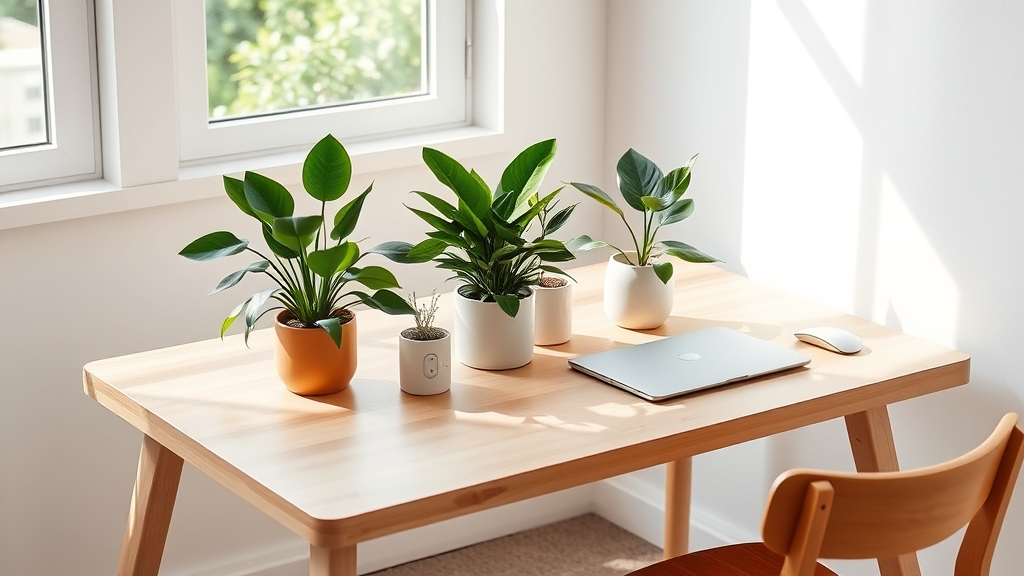
Step-by-Step Guide to Building Your Desk Plant Setup
Ready to enhance your home office with real benefits? Here’s how to build a biophilic desk plant setup that delivers on focus, comfort, and data-driven feedback:
- Pick the right plants. Choose research-supported, low-maintenance species: spider plant (Chlorophytum comosum), snake plant (Sansevieria/Dracaena trifasciata), golden pothos (Epipremnum aureum), and peace lily (Spathiphyllum wallisii). Spider and snake plants are pet-safe and thrive in low to moderate light.
- Assess your space and light. Check that your desk gets enough natural or artificial light. North- and east-facing windows are best. Use a simple LED grow lamp if your desk is windowless.
- Prep for smart plant care. Use self-watering pots, sealed pot covers, and simple moisture meters to avoid root rot and mold (the top complaint from plant owners).
- Group plants in view. Arrange 2–4 plants within your direct line of sight, about 1–2 feet from where you work. This maximizes psychological benefits and comfort cues.
- Add a consumer air quality monitor. Invest in a basic model that tracks CO2 and relative humidity (RH), or step up to a device with PM2.5 and TVOC if you want more environmental feedback. Aim for ±3% RH accuracy and CO2 detection down to 400 ppm for actionable trends (see the American Lung Association).
- Establish your baseline. Run your air quality monitor home office for 7 days before introducing plants. Log RH, CO2, and VOC readings (if available); also note subjective feelings: alertness level, stress, or fatigue.
- Add your plant group and observe changes. Track for 1–2 weeks. Expect to see rises in RH (2–7% increase), stable or improved CO2 (if ventilation is good), and likely no change in TVOC—real-world VOC reduction needs many dozens of plants per square meter.

Quick Shopping List & Budget Estimates
- Plants: Spider plant ($12–20), snake plant ($15–30), peace lily ($15–25), pothos ($12–20). Pick two for a starter duo.
- Self-watering pots: From $10–15 each.
- Air quality monitor home office:
- Basic (CO2/RH): $60–90 (e.g., Inkbird, ThermoPro)
- Advanced (CO2/PM2.5/TVOC): $150–250 (e.g., Qingping Pro, Airthings View Plus)
- Optional: LED grow lamp ($25–50), moisture meter ($12–20), LECA pellets ($15/bag).
Pocket Protocol: Mini-Experiment With Your Monitor
- Track CO2 and RH for a full week with no new plants (maintain usual window use).
- Add 2–4 desk plants grouped in view.
- Repeat monitoring for two weeks. Focus on changes in RH and perceived comfort, not VOC readings.
- Interpret: If RH rises by even 3–7% and you feel more focused/less stressed, your biophilic desk plant setup is working—regardless of VOC readings.
For a detailed guide on building ergonomic comfort at your workspace, check out our Ergonomic Office Chair Buying Guide.
Advanced Analysis & Common Pitfalls
Even the most well-intentioned setups run into surprises. Here’s what the latest research and real users report—plus how to dodge key mistakes:
| Issue | What Happens | Action/Prevention |
|---|---|---|
| Overwatering/Mold | Mold, fungus gnats, and increased allergens | Use self-watering pots, moisture meters, and let the top inch of soil dry before watering |
| Pests (gnats/aphids) | Unwanted bugs on plants or around your workspace | Choose sterile media (LECA), bottom-water only, yellow sticky traps for early detection |
| Light Mismatch | Plants grow leggy, leaves yellow or drop | Pick plants matched to your actual light; use an LED grow lamp if needed |
| Space Constraints | Cluttered desk reduces workspace and plant health | Choose compact varieties, mount on shelf risers, or use wall planters |
| Allergic Reactions | Mild respiratory irritation or allergy to mold/spores | Avoid overwatering, skip flowering varieties, use HEPA filter in high-sensitivity homes |
| Pet Safety | Toxicity risk if pets chew leaves (e.g., pothos, philodendron) | Choose non-toxic species; keep out of reach or use pet barriers |
| Unrealistic VOC Removal Expectations | No detected VOC improvement on monitor with small plant numbers | Understand the reality—removal needs 10–1,000 plants per m². Focus on comfort and RH, not VOC metrics |
What Air Quality Monitors Actually Measure (and What to Ignore)
Most air quality monitor home office devices track CO2, PM2.5, TVOCs, temperature, and RH. For the typical desk setup, ignore TVOC readings as proof of plant “cleaning”—multiple reviews confirm that only sealed-chamber studies, with huge numbers of plants, reach measurable change (Drexel research). Instead, use these monitors for:
- Managing CO2: High levels (800+ ppm) cause focus fatigue—open a window or use a fan to ventilate and watch numbers drop.
- Checking Relative Humidity (RH): Target 40–60% for comfort—plants can boost RH noticeably in dry climates.
- Tracking Temperature: Not directly plant-related, but useful for comfort and care.
Pro tip: If your monitor only has an “air quality” color code, dig into settings for actual CO2/RH numbers, as these are far more actionable than a green/red LED.
Want a more ergonomic and spacious desk in your new green setup? Explore our Best Desks for Small Home Office guide.
Recent Case Studies & Lessons (2022–2024)
- Case 1: Remote workers adding three spider plants saw subjective mood and focus rise within a week; CO2 and RH readings remained stable. No change in TVOCs as expected, matching the research consensus.
- Case 2: Users who overwatered desktop peace lilies reported mold and gnats, leading to allergic symptoms—solved with a switch to self-watering pots and periodic topsoil drying.
- Case 3: High-end air quality monitors validated ventilation (CO2 drops with open window) but detected no difference in VOCs after adding four golden pothos plants, confirming that plant counts were too low for measurable change.
Key lessons: enjoy the psychological and comfort benefits, manage pests and moisture, and don’t expect magic VOC removal from a small plant group.

Conclusion & Clear Next Steps
A practical biophilic desk plant setup delivers real-world boosts for mood, creativity, and self-reported work speed—6–12% faster tasks, 14–15% higher wellbeing—by leveraging simple, visible greenery and small humidity lifts. Don’t expect a handful of plants to clean your air; the research proves a gap of 10–1,000 plants per m² would be needed for volumetric VOC removal. Instead, use your air quality monitor home office to track CO2 and RH, validate improvements in comfort, and optimize ventilation when needed. Upgrade your entire setup with strategic choices for plants, pots, and monitoring for a quantifiable wellness and productivity edge. Ready to get started? Follow our 30-day implementation below and build a healthier, happier workspace that really works for you!
For more workspace comfort upgrades, read our ergonomic keyboard guide, consider a high-quality standing desk converter, or browse recommendations for the best monitor light bar.
FAQs: Biophilic Desk Plant Setup & Air Quality Monitor Home Office
Do desk plants really improve productivity and mood?
Yes. Multiple field studies (including large-scale 2024 reviews) show 6–12% improved task speed and up to 15% better self-reported wellbeing for people who work in environments with visible plants.
Will adding plants reduce VOCs or clean my indoor air?
Not measurably, unless you add 10–1,000 plants per square meter—a level far beyond normal home offices. Small plant groups help humidity and comfort, but don’t provide significant real-world air cleaning according to the American Lung Association.
Which plants are best for my desk?
Spider plant, snake plant, golden pothos, and peace lily all have lab-proven resilience and (in sealed chambers) limited pollutant removal. However, for pet owners, spider and snake plants are safest. Pick based on light level and space.
How do I use my air quality monitor with desk plants?
Track baseline CO2 and humidity for a week, add your plants, then monitor again for at least two weeks. Look for RH increases and stable or lower CO2—ignore VOC readings for plant impact.
What if I notice mold, gnats, or allergies?
Reduce watering, switch to self-watering or LECA setups, and keep plant leaves and soil clean. Avoid flowering species if you have pollen allergies. Pet owners should stick to non-toxic plants.