

AI posture tracking chair solutions are rapidly transforming how enterprises approach employee wellbeing and office ergonomics — but how do you separate vendor hype from the technical and ergonomic facts that truly impact procurement, product design, and workforce health?
Key Takeaways
- The global smart chair market is projected to grow from USD 1.3 billion (2024) to approximately USD 2.8 billion by 2034, with office models leading adoption and a strong CAGR of nearly 8%.
- Real-world feedback highlights recurring issues: sensor drift, discomfort from embedded tech, and inconsistent posture or activity feedback — challenges every buyer and product manager must scrutinize.
- Long-term ergonomic benefits remain promising yet unproven in most studies; due diligence around calibration, comfort validation, and data integration is essential for ROI and user satisfaction.
- Quick market snapshot & growth outlook
- How AI posture tracking chairs actually work — sensors, algorithms, integration
- Evidence-based ergonomic & health benefits — what the data supports and where evidence is thin
- Most common real world user complaints (reliability, comfort, data accuracy)
- Three crucial sub topics competitors often miss (make this a lead insight)
- Average price ranges, warranty norms, and ongoing costs — what procurement should expect
- Major manufacturers (2024) and flagship model tech snapshots
- Technical spec checklist for RFPs or pilot evaluations
- Procurement pilot plan (how to run a 30–90 day enterprise pilot)
- Future trends & R&D directions to watch
- Sources to cite and further reading
- FAQ
Quick market snapshot & growth outlook
The smart chair market, including both AI posture tracking chair products and smart lumbar support office chairs, is valued at roughly USD 1.3 billion in 2024. Office-focused models account for about one-third, a figure propelled by investments in workplace wellness and modern office upgrades.
Market analysts forecast this segment to grow to nearly USD 2.8 billion by 2034, recording a CAGR of approximately 7.8% (Market.US Research). North America leads with a 43% regional share, reflecting a strong enterprise demand for sensor-embedded seating in hybrid-remote environments. Mid and large enterprises are driving adoption, with key drivers including:
- Corporate return-to-office initiatives and ergonomic upgrades
- Greater awareness of musculoskeletal health and productivity links
- Integration with digital wellness platforms

Adjacent categories like smart home seating and gaming chairs contribute to overall growth but represent a distinct set of user needs and standards. Procurement teams should focus on office-specific technical, ergonomic, and data-privacy requirements during sourcing and evaluation phases.
How AI posture tracking chairs actually work — sensors, algorithms, integration
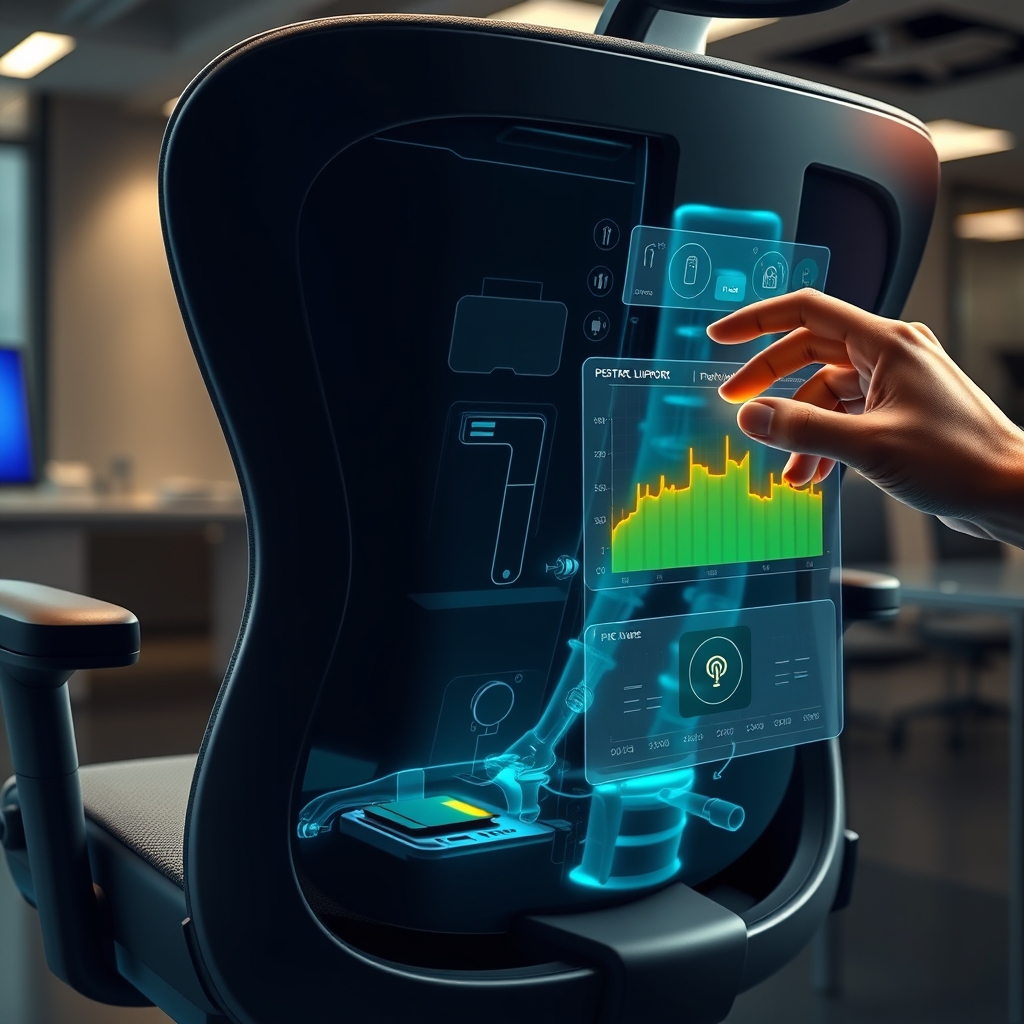
An AI posture tracking chair typically integrates a set of pressure (FSR), capacitive, load cell, or inertial measurement unit (IMU) sensors embedded below the seat pan and backrest. These hardware components record biomechanical signals and body-surface pressure patterns in real time.
The sensor data feeds into posture-classification machine learning models—often using routines trained for slouching, leaning, or upright postures, with on-device or cloud-assisted calibration. App-based workflows then activate user feedback, guidance pop-ups, or automated lumbar adjustments, typically over Bluetooth or Wi-Fi. Vendors position AI-driven feedback as more adaptive than rule-based approaches, offering notifications, reports, or even live suggestions.
However, technical failure modes are well documented:
- Sensor Drift: Over time, calibration changes as foam compresses or sensors age, leading to inaccurate readings or increased false positives.
- False Positives and Data Noise: Non-postural movements (leaning to answer a phone, seat-edge perching) may trigger false alerts.
- BMI and Body Type Effects: A 2019 IJCAI study found posture accuracy varies by BMI — 0.9704 (low BMI), 0.9849 (normal BMI), and 0.9883 (high BMI) (IJCAI Study).
- Connectivity Gaps: Bluetooth/Wi-Fi disconnects and app synchronization delays are common complaints, especially in large offices.
Integration is critical. The best smart lumbar support office chair options make secure APIs available for workplace health dashboards and Single Sign-On (SSO), but many products remain locked in vendor apps, complicating fleet-wide deployment or wellness analytics.
Leading models also focus on user privacy. Enterprise buyers should confirm end-to-end data encryption and the ability to restrict health data integration to approved wellness systems.
Evidence-based ergonomic & health benefits — what the data supports and where evidence is thin
Claims that an AI posture tracking chair (or smart lumbar support office chair) will eliminate back pain or transform employee engagement should be scrutinized. Here’s what current evidence supports:
- Supported Benefits: Modest gains in posture awareness, analytic reporting of sitting patterns, and guided posture correction. Users may experience shorter uninterrupted sitting bouts with real-time feedback.
- Thin Evidence: Systematic reviews (see PMC review) note reliability and accuracy issues. Few long-term RCTs prove lasting ergonomic health improvements, due in part to limited multi-month adherence in uncontrolled environments.
- Methodological Gaps: Studies often use small or homogeneous samples and rarely track wear-and-tear effects on calibration or user fatigue with notifications.
As a result, buyers and product teams should view AI chairs as tools to amplify posture-related behavior change, not as silver-bullet health interventions. For procurement, focus on features that enhance awareness and can be tuned for your workplace’s unique risk profile.
For other strategies to support office ergonomics, consider evidence-based ergonomic office chairs or standing desk converters for diverse workforce needs.
Most common real world user complaints (reliability, comfort, data accuracy)
Smart chair user reviews and technical support data consistently surface three negative themes:
| Problem Area | Description | Frequency (User/Tech Feedback) |
|---|---|---|
| Sensor Unreliability / Drift | Periodic recalibration required; erratic posture reports; increased false positives as foam or mechanisms age. | High |
| Physical Discomfort | Added hardware (lumbar gears, heating/cooling); stiffer or bulkier backrest mechanisms; pressure points from sensors. | Medium to High |
| Inaccurate or Delayed Feedback | App lag; unclear notifications; battery drop-off; syncing issues; limited integration with enterprise wellness. | High |
Procurement teams should prioritize hands-on trials to confirm comfort across diverse body types and scrutinize support SLAs for calibration and sensor issues. Internal wellness champions often highlight frustration with inconsistent app feedback—similar to feedback seen in ergonomic footrests or lumbar support pillows where real comfort trumps features.

Three crucial sub topics competitors often miss (make this a lead insight)
Despite rapid adoption and vendor product launches, three critical areas remain under-discussed in most buying guides and technical reviews:
- Sensor Technology & Calibration Protocols: Many vendors lack transparent documentation for maintaining measurement fidelity over time. Look for published calibration routines, accessible sensor test modes, and procedures for multi-user environments.
- Rigorous Ergonomic Comfort Validation: Request evidence of comfort testing across a range of BMIs, heights, and gender identities. User trials should report not just satisfaction scores but pressure mapping and fatigue—an approach common in advanced product management.
- Data Privacy, Security, & Enterprise Integration: Confirm exactly how workplace data is secured, audit APIs, and demand integration options for enterprise wellness dashboards to support GDPR or HIPAA-aligned privacy policies.
Analyst reports and research syntheses (Strategic Market Research) flag these as persistent gaps in the smart lumbar support office chair landscape.
Average price ranges, warranty norms, and ongoing costs — what procurement should expect
AI posture tracking chair and smart lumbar support office chair pricing varies substantially by feature set, deployment scale, and brand:
- Entry/Small Business: USD 350-700 per unit (fixed sensor set, basic app, standard foam / lumbar mechanism, typically 1-year warranty)
- Premium/Enterprise: USD 900-2,800+ per unit (AI-driven adjustments, advanced analytics, BYOD/BYOD-ready, 3- to 5-year warranties, rolling maintenance contracts)
- Costs to Monitor: App subscriptions (USD 3-10/month/user), battery or hardware service (post-warranty), API or platform integration fees, and extended support SLAs.
Warranty and service terms differ widely. Vendors may bundle or upcharge for advanced analytics, hardware swaps, or multi-year enterprise support. Always demand explicit written agreements for warranty length, service response (Mean Time To Repair), and app access.
Consider total cost of ownership (TCO) and recurring charges—an approach parallel to high-value procurement such as monitor arms or docking stations. Always require clear documentation of hardware, data, and app lifecycle guarantees.
Major manufacturers (2024) and flagship model tech snapshots
The following vendors currently lead the enterprise-oriented smart seating market for 2024:
- Steelcase: In January 2024, released the Gesture Pro, featuring real-time AI posture coaching, hybrid IMU and FSR sensors, and advanced app analytics. Firmware supports enterprise SSO (Industry Report).
- Herman Miller & Steelcase Partnership: Announced a strategic partnership to accelerate AI-office seating innovation, focusing on modular platforms and data security (Strategic Market Research).
- Backrobo: Released the Air Smart Chair C2 (July 2024), offering posture classification via cloud-based AI, adjustable lumbar modules, user-driven comfort mapping, and app-driven habit analytics (Backrobo Tech Overview).
- Humanscale: Launched the Smart Ocean, incorporating recycled materials and sensor-driven activity monitoring in an eco-designed frame.
- X-Chair: Provides smart seat upgrade kits with hybrid lumbar and cooling technology but less focus on enterprise data workflows.
Innovation and partnerships—like the HNI and Steelcase mega-deal—signal further consolidation, new product launches, and a rapid feature arms race in the smart chair sector.
Technical spec checklist for RFPs or pilot evaluations
When drafting RFPs or evaluation criteria for an AI posture tracking chair fleet, include the following technical requirements:
- Sensor Types (FSR, capacitive, IMU), exact placement diagrams, replaceability
- Calibration protocol transparency—can staff recalibrate and does system provide error feedback?
- Sampling rate and feedback response time; vendor SLA for minimum latency
- Posture-detection and feedback accuracy, with validation by BMI or body type
- Battery life, recharge window, and field serviceability/maintenance requirements
- App/API integrations (SSO enablement, bulk provisioning, direct-to-dashboard exports)
- Data export (CSV, API) and granular privacy controls compliant with regional policy
- Warranty duration, on-site support timelines (Mean Time To Repair), and spares availability
- User comfort validation trial reports (population, protocol, pressure mapping, survey data)
Checklist items directly mitigate the top pain points: unreliable sensors, comfort issues, and inaccurate or delayed feedback. Consider referencing guides for holistic workspace fit, such as standing desk converters and ergonomic footrests.
Procurement pilot plan (how to run a 30–90 day enterprise pilot)
A robust pilot maximizes the chance of successful rollout:
- Define sample size by user cohort. Include a representative spread across BMIs, heights, genders, and workstation layouts.
- Record baseline metrics. Capture self-reported discomfort, posture, and activity data before deployment.
- Deploy chairs alongside engagement/app instructions. Ensure all users calibrate with support; track calibration events and drift/recall needs for ongoing fidelity assessment.
- Monitor key metrics. Engagement (daily active users), posture improvements, comfort scores, notification fatigue, app integration stability.
- Validate and document data. Compare chair feedback against manual/postural expert observations to check for false positives and sensor accuracy across body types (IJCAI Study).
- Secure privacy consent and run integration tests. Confirm user data rights, activate SSO, and test API-driven exports for corporate dashboards.
- Assess vendor support and SLA performance. Log issue response times and field service calls to evaluate long-term rollout risk.
After the trial, conduct post-pilot interviews and data analysis to inform a go/no-go decision or adjust procurement specs.
Future trends & R&D directions to watch
Over the next 3 to 5 years, smart chair innovation will center on:
- Deeper integration with employer wellness dashboards via standardized APIs, enabling aggregated analytics and company-wide insights
- Enhanced sensor fusion (combining pressure, IMU, and optical data) and smarter auto-calibration for lower drift rates
- Greater personalization based on user morphology, activity, or adaptive reminders
- Sustainability: more models will use recycled or modular materials, following pioneers like Humanscale’s Smart Ocean
- Industry consolidation as legacy ergonomic brands partner or merge with tech-first startups (e.g., Steelcase/Herman Miller deal)
Enterprises and startups should monitor R&D for improvements in real-world effectiveness and serviceability, with long-term ROI driven by both health and operational metrics.
Sources to cite and further reading
- Smart Chair Market 2024–2034 Data (Market.US)
- Smart Sensing Chairs Review (PMC)
- Machine Learning Posture Detection Technical Study (IJCAI)
- Ergonomic Chair Market Report/News (Strategic Market Research)
- Backrobo Air Smart Chair C2 Product Overview
For additional research-backed office ergonomics tips, see our guides on ergonomic office chairs, footrests, and laptop stands.
FAQ
What is the most common failure mode for an AI posture tracking chair?
Sensor drift and calibration loss are the most reported failures—leading to inaccurate posture alerts and increased user frustration.
How accurate are posture detection systems for all user types?
Accuracy varies by body type and BMI. Studies show accuracy rates ranging from 97% to 99% depending on user group, with some models requiring more recalibration for extreme body sizes.
Do these chairs actually reduce back pain long-term?
There is modest evidence for improved posture awareness, but no large-scale studies confirm a significant, sustained reduction in back pain over months. Use them as behavioral nudges, not cure-alls.
What price should procurement expect for a smart lumbar support office chair?
Entry-level models start at around USD 350-700, while advanced enterprise platforms may cost USD 900-2,800 or more per chair, not including software subscriptions and support contracts.
What are key RFP or spec checklist items to include?
Request detailed specs: sensor placement and replaceability, calibration protocols, response time, multi-user accuracy metrics, API support, comfort validation, and clear warranty/service SLAs.